
Joint hypermobility and EDS
Physiotherapy for Hypermobility and EDS
Some joints bend further than most. If yours hurt or slip out of place, we help you build strength and control, slowly and at your pace.
Free first visit for new patients · No referral needed · Open evenings and Sundays
- 4.9 on Google
- No Referral Needed
- Registered Physiotherapist
- One on One Visits
- Direct Billing Available
What Is Joint Hypermobility?
Joint hypermobility means your joints bend further than most people's. For many people, this causes no trouble at all. The 2017 international framework on hypermobility says it is often a trait with no symptoms.
Doctors often measure it with the Beighton score. This is a short test of how far some joints bend, like your thumbs and knees.
For some people, bendy joints do cause problems, such as pain or joints that slip. That is when a doctor may think about one of the two names below.
HSD and hEDS in Plain Words
Both names come from papers an international group of experts wrote in 2017.
Hypermobility spectrum disorder (HSD)
HSD is the name for bendy joints that cause problems, like pain or joints that slip. It is used when the signs don't fit hEDS or another syndrome.
Hypermobile Ehlers-Danlos syndrome (hEDS)
Ehlers-Danlos syndromes (EDS) are 13 types of inherited conditions. They affect connective tissue, the tissue that holds your body together. hEDS is one type, and it has no gene test yet, so doctors use a checklist.
A doctor diagnoses EDS. Physiotherapists don't make this diagnosis. Your family doctor may send you to a rheumatologist (a doctor who treats joints) or to a genetics clinic. The rarer types of EDS have gene tests, and some of them can be serious, so this step matters.
Common Problems People Come In With
Research on HSD and hEDS describes these common problems.
- Joint or muscle pain that comes and goes
- Sprains, like a rolled ankle
- Joints that slip partly out of place (a subluxation) or all the way out (a dislocation)
- Weak muscles around loose joints
- Poor balance, or a weaker sense of where your joints are (body awareness)
- Tiredness (fatigue). Many people say it is harder to live with than the pain.
Some people also feel dizzy when they stand up. That needs a doctor first. See the signs further down this page.
What the Research Says
In 2017, an international group of EDS researchers wrote advice on physiotherapy for hEDS and related conditions. They said physiotherapy plays a central role in care. They advised building exercise up slowly to avoid injury and overdoing it. They also said the research was limited in size and quality.
Newer reviews say much the same. A 2022 review of 10 studies with 330 adults found that exercise and rehab may help. It also said there were too few good studies to be sure.
A 2024 review looked at shoulder care in hEDS and HSD. It found only 4 studies, which tested exercise programs and other care such as taping. In those studies, pain and shoulder function tended to improve over time. The authors said big gaps in the research remain.
One trial tested strength training. In it, 100 adults with HSD and shoulder pain or looseness did 16 weeks of shoulder exercise. The group lifting heavier loads reported a little better shoulder function than the group lifting lighter loads. The gap was smaller than the amount the researchers set as a clear change.
So exercise and strength work have some support. The research is still small, and we will be upfront with you about that.
How We Help
Your plan depends on your body and your goals. Here is what it often looks like.
A careful assessmentFree for new patients
We ask about your history and your hard days, then check how your joints move and how you balance. It takes about 60 minutes and includes your first treatment.
Gentle strength and control work
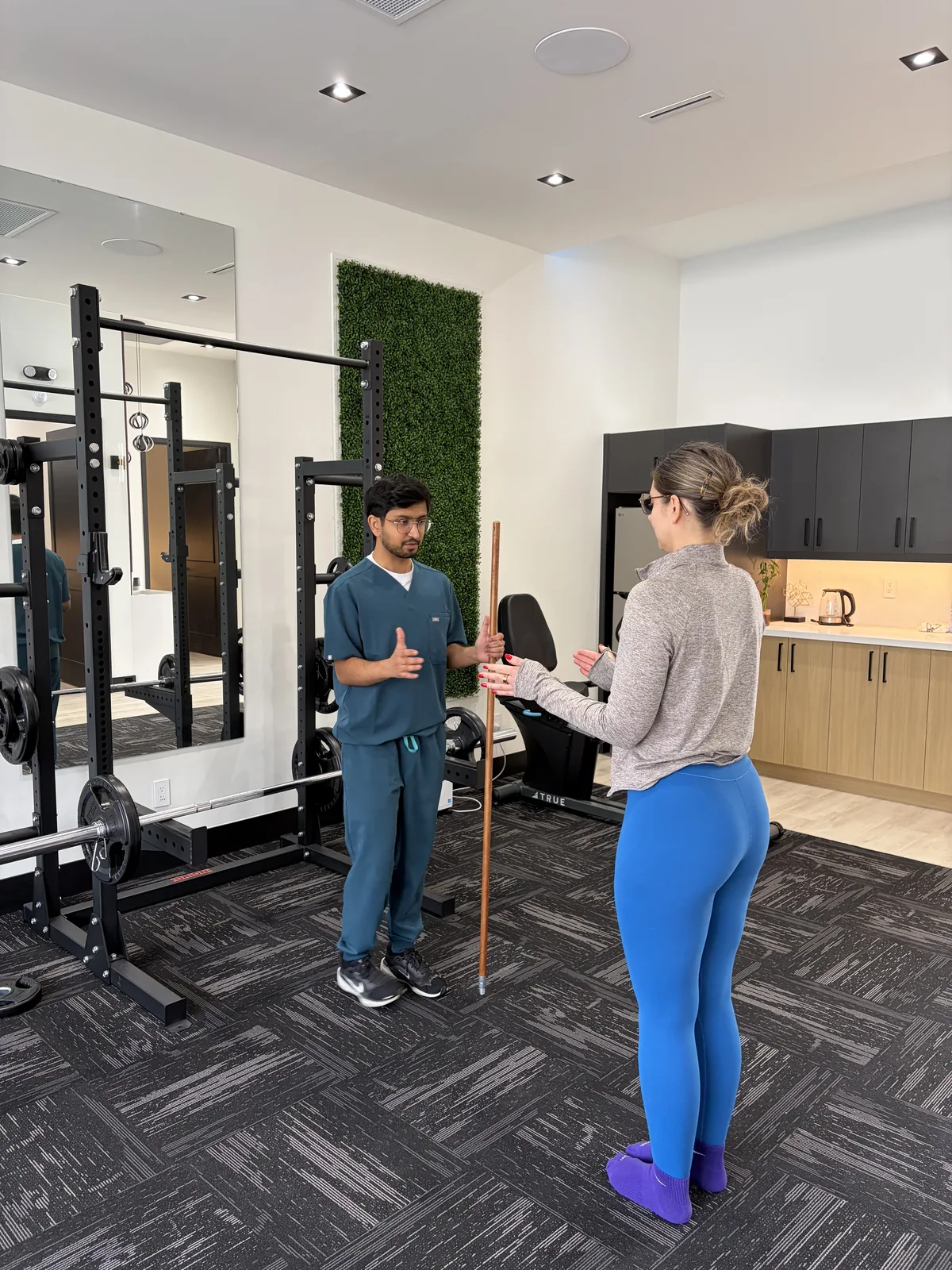
We start with easy exercises that work on holding your joints steady, in our on-site gym and at home. We focus on the joints that bother you, such as your shoulder or knee.
Pacing and a slow build-up
We add a little at a time and check how you recover, as the 2017 advice suggests. If tiredness is a problem, we help you pace your day, an approach the NHS also describes.
A plan for flares
Together we write a simple plan for bad days. It says what to scale back and how to build up again after.
Taping where it helps
We may try tape on a joint during a flare or while you learn a new exercise. The research on taping here is small, so we keep using it only if you find it useful.
A home program you can keep up
You leave with a short list of exercises that fits your energy on good days and on bad days.
When to See a Doctor First
Some signs need a doctor before physio. A few need care right away.
Call 911 or go to the ER now
- Chest pain or trouble breathing
- A joint that has come out of place and won't go back in
- Sudden numbness or weakness in your arms or legs
See a doctor first
- Dizziness, a racing heart or fainting when you stand up
- Bad headaches that get worse when you sit up or stand
- New numbness, tingling or weakness in your arms or legs
Physio is a good place to start
- Joint or muscle pain that comes and goes with activity
- Sprains, or joints that feel loose or give way
- Feeling unsteady, or less sure of where your joints are
- You have HSD or hEDS and want to get stronger at your own pace
No referral needed in Ontario. If you need a doctor, we'll tell you at your first visit.
Think you may have EDS? You can start physio while you wait to see your doctor. Your doctor can check for the rarer types, which are found with gene tests.
Google reviews
What Patients Say About Our Clinic
Copied word for word from Google. Names are shortened for privacy. A … means part of a longer review is left out.
Very thorough assessment. I am very pleased with the attention to details and help recieved from this clinic.
Very clean, welcoming environment.
Friendly and helpful staff.
Would definitely recommend to anyone.
I would highly recommend Interlink for physiotherapy sessions. Dhiman is very knowledgeable and patient, taking the time to fully understand what your issues are and making sure he gets a full picture before beginning treatment. He includes you in setting goals and expectations. His treatments are varied and he explains why we would do each exercise. Furthermore, he would provide exercises or stretches to complete at home. Always felt at ease and comfortable to ask any questions or further clarification on anything discussed. …
The space is very clean and the equipment kept in great shape.
All staff are very welcoming and friendly making for a great atmosphere for recovery.
I came in with a workplace injury on my foot and was having trouble with mobility and pain. Dhiman was incredibly professional and passionate with his approach on my care plan. … I highly recommend him since he takes the time to listen and explain things clearly so we as clients can understand the injury and process on healing. …
Hypermobility and EDS FAQs
Can a physiotherapist tell me if I have EDS?
No. A doctor makes that diagnosis, often a rheumatologist or a genetics clinic. You don't need a diagnosis to start physio, and we'll tell you if something needs your doctor.
Do I need a referral?
No referral is needed in Ontario. Some insurance plans want a doctor's note before they pay, so check your plan.
Can I do strength training if I'm hypermobile?
Research has tested it. In one trial, adults with HSD and shoulder pain did 16 weeks of shoulder strength work with heavier or lighter loads. We start light and add a little at a time.
Can physio keep my joints from slipping out?
We can't promise that. We work on strength and control around the joint, but the research on this is still small. If a joint slips out often, your doctor should know.
What if exercise makes me flare?
Tell us, and we'll scale back and build up again more slowly. The 2017 physiotherapy advice says to watch training loads so your body has time to recover.
Can physio help with dizziness?
Dizziness when you stand up needs a doctor first. Some dizziness comes from the inner ear, like short spins when you roll over in bed. We can check for that at your first visit. See vestibular physiotherapy.
What does the first visit cost?
Your first visit is free for new patients: a full assessment and your first treatment. It's never billed to your insurer, and there's no obligation to continue. Follow-up visits are $95 for 30 minutes, one on one with a registered physiotherapist.
Where are you, and is it easy to get in?
We're at 1280 Mohawk Rd #103 in Ancaster, just east of the Meadowlands. Parking is free right outside the door, and the entrance is on the ground floor with no stairs.
Start at a Pace That Suits You
Your first visit is free for new patients: a full assessment and your first treatment. It's never billed to your insurer, and there's no obligation to continue.
New patients only · Never billed to your insurer · No referral needed
The Research on This Page
- Castori M, et al. A framework for the classification of joint hypermobility and related conditions. American Journal of Medical Genetics Part C, 2017. Link
- Malfait F, et al. The 2017 international classification of the Ehlers-Danlos syndromes. American Journal of Medical Genetics Part C, 2017. Link
- Engelbert RHH, et al. The evidence-based rationale for physical therapy treatment of children, adolescents, and adults diagnosed with joint hypermobility syndrome/hypermobile Ehlers Danlos syndrome. American Journal of Medical Genetics Part C, 2017. Link
- Buryk-Iggers S, et al. Exercise and rehabilitation in people with Ehlers-Danlos syndrome: a systematic review. Archives of Rehabilitation Research and Clinical Translation, 2022. Link
- Higo A, et al. The effectiveness of conservative interventions on pain, function, and quality of life in adults with hypermobile Ehlers-Danlos syndrome/hypermobility spectrum disorders and shoulder symptoms: a systematic review. Archives of Rehabilitation Research and Clinical Translation, 2024. Link
- Liaghat B, et al. Short-term effectiveness of high-load compared with low-load strengthening exercise on self-reported function in patients with hypermobile shoulders: a randomised controlled trial. British Journal of Sports Medicine, 2022. Link
- NHS. Ehlers-Danlos syndromes. NHS website, page reviewed 2022. Link
- Hakim A, et al. Cardiovascular autonomic dysfunction in Ehlers-Danlos syndrome, hypermobile type. American Journal of Medical Genetics Part C, 2017. Link
- Severance S, et al. Hypermobile Ehlers-Danlos syndrome and spontaneous CSF leaks: the connective tissue conundrum. Frontiers in Neurology, 2024. Link
This page shares general information only. It can't tell you what is causing your symptoms. Your physiotherapist or doctor can tell you what fits your situation.
Reviewed by Dhiman Patel, MScPT, registered with the College of Physiotherapists of Ontario. Last reviewed 23 September 2026.