
ACL tears and ACL surgery
ACL Rehab in Ancaster and Hamilton
Rehab for a torn ACL, whether or not you have surgery. Strength and hop tests help you and your team decide when you're ready for sport.
Free first visit for new patients · No referral needed · Open evenings and Sundays
- 4.9 on Google
- No Referral Needed
- Direct Billing Available
- One on One Visits
- Open Evenings and Sundays
What an ACL Tear Is
Your ACL (anterior cruciate ligament) is a strong band of tissue inside the knee. It joins your thigh bone to your shin bone and helps keep the knee steady. Common signs of a tear:
- A pop you hear or feel when it happens
- Swelling that shows up within a few hours
- Pain when you put weight on the leg
- The knee feels loose or gives way when you stand on it
Your physiotherapist also checks the rest of the knee, like the meniscus (a rubbery pad inside the knee). See knee physiotherapy and meniscus tear physiotherapy.
Rehab Before Surgery (Prehab)
The first goals of prehab are to settle the swelling and get the knee fully straight. Then you build strength in your quads, the big muscles on the front of the thigh.
A 2023 rehab guideline says prehab might help thigh strength and knee movement after surgery. It suggests at least one visit first, to check that your quads switch on and the knee fully straightens.
One report from the Delaware-Oslo study looked at 84 people who did rehab before and after surgery. Before surgery, they aimed for at least 90% of the other leg's strength and hop scores. Two years later, 86% to 94% of them scored in the normal range on each part of a knee survey. Among 2,690 people from Norway's national list of ACL surgeries, 51% to 76% did. People were not put into groups by chance, so other things may explain part of this gap.
Surgery or Rehab Alone? What the KANON Trial Found
Some people with a torn ACL do well with rehab alone. Others need surgery to rebuild the ligament (ACL reconstruction). You and your surgeon choose together.
The KANON trial in Sweden included 121 active adults aged 18 to 35 with a new ACL tear. Everyone did a planned rehab program. One group also had surgery early. The other group did rehab first and could have surgery later if the knee kept giving way.
After 2 years, both groups had about the same scores for pain, symptoms, sport and quality of life. In the rehab first group, 23 of 59 people had surgery later, and 36 had rehab alone.
After 5 years, the scores were still about the same. By then, 30 of 59 people (51%) in the rehab first group had had surgery. The two groups had about the same amount of meniscus surgery and arthritis on X-ray. Knees that had early surgery were more stable when a doctor tested them.
The trial suggests both paths are reasonable for young, active adults, though it can't say which one fits you. We can help you build strength while you decide.
Rehab After Surgery, Phase by Phase
These times are rough guides from a 2023 rehab guideline and the Delaware-Oslo study. You move to each phase when you pass its checks.
| Phase | Rough timing | What you work on |
|---|---|---|
| Early | About the first month | Calm the swelling and get the knee fully straight. Wake up your quads and walk well again, as your surgeon allows. |
| Strength | About months 1 to 4 | Build strength in your thigh and hip. Work on balance and control on one leg. |
| Running | Often from about 12 weeks, once you pass checks | Start with easy runs. Checks include no swelling and a fully straight knee, with quads strength over 80% of the other leg. |
| Sport-specific | Often from about month 4 | Jumping, landing, quick turns and drills for your sport. |
| Return to sport | 9 months or later, once you pass tests | Strength and hop tests compare your legs. You decide with your surgeon and physiotherapist. |
Studies suggest starting to run at 8 to 16 weeks, and research hasn't settled whether 12 weeks or sooner is safe. Your surgeon's plan comes first. See rehab after surgery.
Testing Before You Go Back to Sport
Guidelines use tests, along with time since surgery, to decide when you're ready. Common tests compare your legs, like thigh strength and hops on one leg. See sports injury physiotherapy for more.
A second report from the same study followed 106 people who played sports with quick turns, for 2 years after ACL surgery. Some went back to sports with jumping and quick turns, like soccer. They had about 4 times more knee re-injuries than people who didn't.
Going back early raised the risk. For each month people waited, up to 9 months after surgery, their re-injury rate went down by 51%. Waiting past 9 months did not lower it more. People whose thigh strength was more even between legs also had fewer re-injuries.
The study also had pass or fail tests. To pass, people needed a score over 90 on each of 7 tests of strength, hopping and knee function. Of people who failed, 38.2% hurt the knee again, compared with 5.6% of people who passed. Only 18 people passed and went back to sport, so this result is less certain.
How We Help at Our Ancaster Clinic
We're on Mohawk Road in Ancaster, on the western edge of the Hamilton Mountain.
Free first visitFree
Your first visit is free for new patients: a full assessment (about 60 minutes) and your first treatment. It's never billed to your insurer, and there's no obligation to continue.
A plan that fits your path
Whether you're having surgery or trying rehab first, we build your plan around your goals. After surgery, we work within your surgeon's plan.
One on one rehab and testing
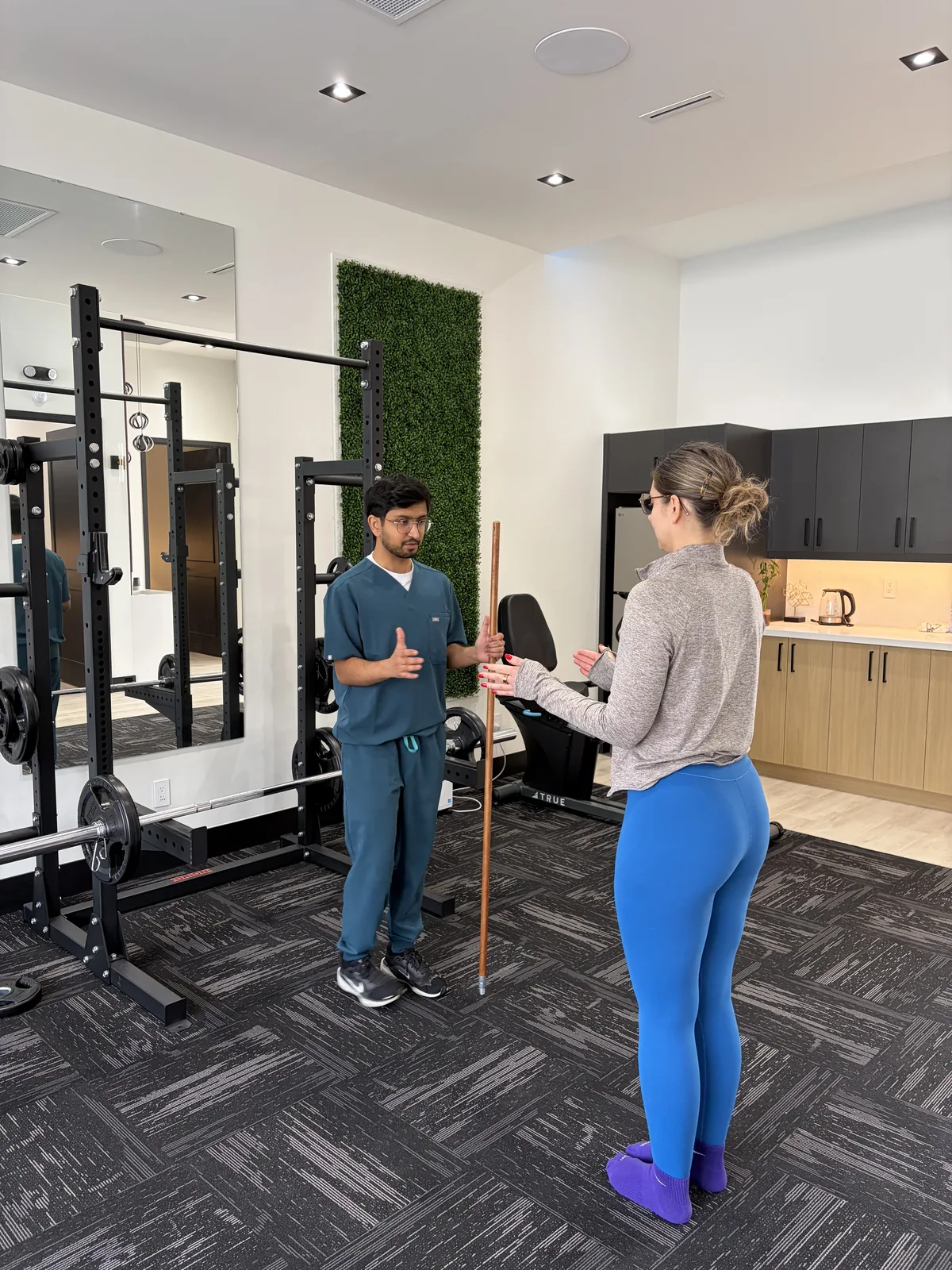
Follow-up visits are 30 minutes, one on one, with training in our on-site gym and at home. Before sport, we compare your legs with strength and hop tests.
When to See a Doctor First
Call 911 for anything in the first list. For the second list, contact your surgeon or doctor the same day.
Call 911 or go to the ER now
- Chest pain or sudden trouble breathing after surgery
- Your foot feels cold, changes colour, or goes numb
See a doctor first
- Your knee locks and you can't straighten it
- Pain or swelling in your calf after surgery
- A fever of 38°C or higher after surgery
- Drainage or redness at your surgery cuts, or bleeding that won't stop
- Your knee keeps giving way
Physio is a good place to start
- You hurt your knee and want to know what's going on
- You have a surgery date and want to build strength first
- Your surgeon says you can start rehab after surgery
- You're trying rehab first or still deciding about surgery
No referral needed in Ontario. If you need a doctor, we'll tell you at your first visit.
Google reviews
What Patients Say About Our Clinic
Copied word for word from Google. Names are shortened for privacy. A … means part of a longer review is left out.
I went for physiotherapy due to knee pain from a running injury. The treatment plan was structured and focused on proper recovery, not just short-term relief. … Highly recommend for sports-related injuries.
I would highly recommend Interlink for physiotherapy sessions. Dhiman is very knowledgeable and patient, taking the time to fully understand what your issues are and making sure he gets a full picture before beginning treatment. He includes you in setting goals and expectations. His treatments are varied and he explains why we would do each exercise. Furthermore, he would provide exercises or stretches to complete at home. Always felt at ease and comfortable to ask any questions or further clarification on anything discussed. …
The space is very clean and the equipment kept in great shape.
All staff are very welcoming and friendly making for a great atmosphere for recovery.
Dhiman went out of his way to support our son during his broken leg recovery. The entire team at Interlink made sure we were cared for, accommodated our schedules and made our son feel special. … Thank you!
ACL Rehab FAQs
Do I need surgery for a torn ACL?
Not always. In the KANON trial, about half the people who tried rehab first had surgery within 5 years. You and your surgeon decide together.
How long does ACL rehab take after surgery?
It's different for everyone and often takes many months. In the Delaware-Oslo study, going back to sports with quick turns at 9 months or later was linked to fewer re-injuries.
Do I need a knee brace after ACL surgery?
Your surgeon decides, and our clinic doesn't sell or fit braces. A 2017 physical therapy guideline says research on braces after ACL surgery points both ways. It says your own wishes should be part of the choice.
Will I get back to my sport?
Many people do. After ACL surgery, 81% of athletes got back to some sport, according to a review cited in a 2017 guideline. Fewer got back to their old level (65%) or to competitive sport (55%).
How much does ACL rehab cost?
Your first visit is free for new patients. Follow-up visits are $95 for 30 minutes, one on one with a registered physiotherapist. We bill most insurers directly. We don't bill OHIP. See fees and coverage.
Is the clinic easy to get to on crutches?
Free parking is right outside the door, and the entrance is on the ground floor with no stairs. We're on Mohawk Road in Ancaster, about 8 minutes from the West Mountain.
Start Your ACL Rehab in Ancaster
Book your free first visit for new patients. We'll assess your knee and map out your next steps with you.
New patients only · Never billed to your insurer · No referral needed
The Research on This Page
- MedlinePlus. Anterior cruciate ligament (ACL) injury: aftercare. US National Library of Medicine, 2025. Link
- MedlinePlus. Knee arthroscopy: discharge. US National Library of Medicine, 2024. Link
- Grindem H, et al. How does a combined preoperative and postoperative rehabilitation programme influence the outcome of ACL reconstruction 2 years after surgery? A comparison between patients in the Delaware-Oslo ACL Cohort and the Norwegian National Knee Ligament Registry. Br J Sports Med, 2015. Link
- Frobell RB, et al. A randomized trial of treatment for acute anterior cruciate ligament tears. N Engl J Med, 2010. Link
- Frobell RB, et al. Treatment for acute anterior cruciate ligament tear: five year outcome of randomised trial. BMJ, 2013. Link
- Grindem H, et al. Simple decision rules can reduce reinjury risk by 84% after ACL reconstruction: the Delaware-Oslo ACL cohort study. Br J Sports Med, 2016. Link
- Kotsifaki R, et al. Aspetar clinical practice guideline on rehabilitation after anterior cruciate ligament reconstruction. Br J Sports Med, 2023. Link
- Logerstedt DS, et al. Knee stability and movement coordination impairments: knee ligament sprain revision 2017. J Orthop Sports Phys Ther, 2017. Link
This page gives general information. Your physiotherapist or doctor can tell you what fits your situation.
Reviewed by Dhiman Patel, MScPT, registered with the College of Physiotherapists of Ontario. Last reviewed 23 September 2026.