
Flat feet in kids and adults
Flat Feet Physiotherapy in Ancaster and Hamilton
Most flat feet are normal and don't hurt. If yours ache, we can check your feet and go over your options.
Free first visit for new patients · Free orthotic assessment · No referral needed
- 4.9 on Google
- Free Orthotic Assessment
- No Referral Needed
- Registered Physiotherapist
- Open Evenings and Sundays
Most Flat Feet Are Normal
A flat foot has a low arch, or no arch, when you stand. Most flat feet are flexible. The arch shows when you sit or lift your foot. It flattens when you stand.
Flat feet are very common in young kids. In a study of 835 children aged 3 to 6, 44% had flexible flat feet. Fewer than 1 in 100 had an abnormal flat foot. Arches often form with age. In that study, 54% of 3-year-olds had flat feet, and 24% of 6-year-olds did.
Many adults have flat feet too. About 20% to 37% of people have some degree of flat feet. Often they cause no symptoms.
When Flat Feet Hurt
Sometimes flat feet do ache. These are common reasons we look for.
- A sore posterior tibial tendon. This tendon is a strong cord. It runs behind the bone on the inside of your ankle and helps hold up your arch. It can get sore or stretched, and sometimes it tears.
- An arch that drops in adulthood. When a flat foot starts later in life, the most common cause is a problem with that tendon. The arch can sink, and the inside of the ankle may ache.
- Arch or heel pain. The plantar fascia is a thick band under your foot. When it's sore, you may feel it in your heel or arch. Our plantar fasciitis page explains more.
Exercises With Research Behind Them
Here are two kinds of exercise that trials have tested for flat feet.
The short foot exercise
Keep your toes relaxed. Gently pull the ball of your big toe toward your heel, so your arch lifts. A 2022 review looked at 6 small trials with 201 adults. People who did this exercise had better arch shape than the other groups.
Strength work for a sore tendon
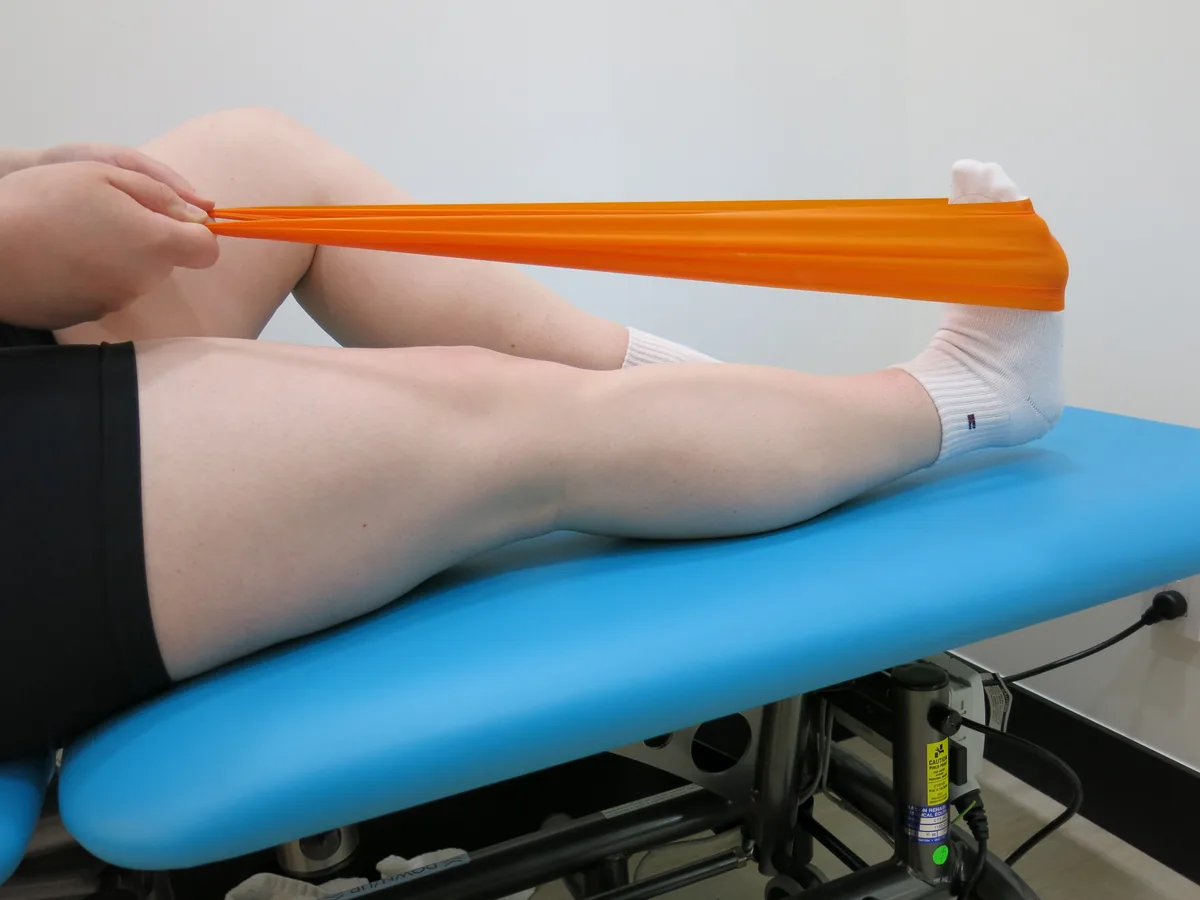
For a sore posterior tibial tendon, trials added strength exercises for that tendon. A 2018 review found only 3 small trials, with 93 people in all. Adding slow lowering exercises to orthotics and stretches eased pain and made daily tasks easier.
Most of these trials were small. Many measured arch shape more than pain. We use them as a guide and check how your feet respond.
When Orthotics Can Help
Orthotics are shoe inserts shaped to your feet. Here's what the research says for different groups of people.
| Who | What the research says |
|---|---|
| Kids with flexible flat feet that don't hurt | A 2022 Cochrane review looked at all the trials. It found that orthotics made little or no difference to pain at one year, compared with shoes alone. This was true for custom and ready-made pairs. It found no support for routine custom orthotics in healthy kids. |
| Adults with flat feet that don't hurt | Advice from the NHS, the UK's public health service, is that you don't need to do anything if your flat feet aren't causing problems. |
| Adults with painful flexible flat feet | In a trial of 67 adults aged 18 to 45, everyone did home exercises for 8 weeks. After 2 months, people with orthotic insoles had less pain than people with fake insoles. Insoles made 2 different ways worked about the same. |
| Adults with an early sore posterior tibial tendon | In a trial of 36 adults, everyone wore orthotics and did stretches for 12 weeks. All groups improved. The group that added slow lowering exercises had the biggest drop in pain. Since everyone wore orthotics, the trial can't show what orthotics add on their own. |
Custom orthotics are one option. Our orthotic assessment is free, whether or not you order. A pair of custom orthotics costs $300 to $500. The fitting visit is a regular $95 visit. We'll tell you if a store-bought insert, custom orthotics or no insert makes the most sense. Read more in Are custom orthotics worth it?
Kids and Adults: What's Different
Kids
Most young children have flat feet. Arches usually form between ages 3 and 10. A stiff or sore flat foot needs a doctor's check.
Adults
Flat feet you've always had are common, and they often don't hurt. A new flat foot, or an arch that's changing, should be checked by a doctor first. In adults, a new flat foot is most often linked to the posterior tibial tendon.
Where does your foot hurt?How We Help at Our Ancaster Clinic
We're at 1280 Mohawk Rd in Ancaster, just east of the Meadowlands. It's about 8 minutes from the West Mountain, with free parking right outside the door.
Free first visitFree
Your first visit is free for new patients: a full assessment and your first treatment. It's never billed to your insurer, and there's no obligation to continue.
We check your feet
We look at your arches as you stand and walk. We check if you can rise onto your toes on one foot. We also test the tendon on the inside of your ankle.
Your home exercise plan
You leave with a few foot and ankle exercises to do at home. We update them at each visit.
Orthotics, if they fit your planFree assessment
If custom orthotics make sense, Unique Orthotics, a lab in Vaughan, Ontario, makes them from a 3D scan of your feet. They're ready in about 1 to 2 weeks. You pay the clinic, then claim from your insurer.
When to See a Doctor First
These signs need a doctor's check before physio.
See a doctor first
- A child's flat foot that is stiff or painful
- A flat foot on one side only
- Flat feet you didn't have before, or an arch that dropped quickly
- You can't rise onto your toes on that foot
- Feet that feel numb or weak, or trouble with walking or balance
- You have diabetes and one foot is warm, red or swollen, even if it doesn't hurt. Get it checked by a doctor within a day.
Physio is a good place to start
- Flat feet that ache after walking or standing
- Pain on the inside of the ankle or in the arch
- Heel pain with your first steps in the morning
- Questions about orthotics, insoles or shoes
No referral needed in Ontario. If you need a doctor, we'll tell you at your first visit.
Google reviews
What Patients Say About Our Clinic
Copied word for word from Google. Names are shortened for privacy. A … means part of a longer review is left out.
I came in with a workplace injury on my foot and was having trouble with mobility and pain. Dhiman was incredibly professional and passionate with his approach on my care plan. … I highly recommend him since he takes the time to listen and explain things clearly so we as clients can understand the injury and process on healing. …
I would highly recommend Interlink for physiotherapy sessions. Dhiman is very knowledgeable and patient, taking the time to fully understand what your issues are and making sure he gets a full picture before beginning treatment. He includes you in setting goals and expectations. His treatments are varied and he explains why we would do each exercise. Furthermore, he would provide exercises or stretches to complete at home. Always felt at ease and comfortable to ask any questions or further clarification on anything discussed. …
The space is very clean and the equipment kept in great shape.
All staff are very welcoming and friendly making for a great atmosphere for recovery.
Very thorough assessment. I am very pleased with the attention to details and help recieved from this clinic.
Very clean, welcoming environment.
Friendly and helpful staff.
Would definitely recommend to anyone.
Flat Feet FAQs
Are flat feet a problem?
Often, no. Flat feet are common and often cause no symptoms. If yours don't hurt or hold you back, you don't need to do anything.
Will my child grow out of flat feet?
Many children do. In one study, 54% of 3-year-olds had flat feet, compared with 24% of 6-year-olds. Arches usually form between ages 3 and 10.
Does my child need orthotics for flat feet?
If the feet bend easily and don't hurt, research doesn't support routine orthotics. A 2022 Cochrane review found they made little or no difference to pain. If your child's feet are stiff or sore, see your doctor first.
Can exercises change my arch?
In small trials, the short foot exercise improved arch shape in adults with flexible flat feet. It's less clear how much it changes pain. For a sore tendon on the inside of the ankle, one small trial found that adding slow lowering exercises eased pain more.
Do I need custom orthotics?
Not always. If your flat feet don't hurt, you likely don't need any insert. If they hurt, we check them at a free orthotic assessment and tell you what makes sense.
How much do custom orthotics cost?
Custom orthotics cost $300 to $500 a pair. The orthotic assessment is free, whether or not you order, and the fitting visit is a regular $95 visit. You pay the clinic, then claim from your insurer.
Do I need a referral to see a physiotherapist?
No. In Ontario you can book with a physiotherapist directly. Some insurance plans want a doctor's note before they pay, so check your plan.
Does OHIP cover physio for flat feet at your clinic?
No. We're a private clinic and don't bill OHIP. If your extended health plan covers physio, we can bill most insurers directly. Your first visit is free for new patients.
Get Your Feet Checked in Ancaster
Book a free first visit for new patients, or a free orthotic assessment. We'll check your feet and explain what makes sense for you.
New patients only · Never billed to your insurer · No referral needed
The Research on This Page
- Pfeiffer M, et al. Prevalence of flat foot in preschool-aged children. Pediatrics, 2006. Link
- Moore J, Tafti D. Pes planus. StatPearls (NCBI Bookshelf), updated 2026. Link
- NHS. Flat feet. NHS website (UK National Health Service), reviewed 2025. Link
- Evans AM, et al. Foot orthoses for treating paediatric flat feet. Cochrane Database of Systematic Reviews, 2022. Link
- Kulig K, et al. Nonsurgical management of posterior tibial tendon dysfunction with orthoses and resistive exercise: a randomized controlled trial. Physical Therapy, 2009. Link
- Ross MH, et al. Exercise for posterior tibial tendon dysfunction: a systematic review of randomised clinical trials and clinical guidelines. BMJ Open Sport & Exercise Medicine, 2018. Link
- Lin YY, et al. Effects of the short-foot exercise on foot alignment and muscle hypertrophy in flatfoot individuals: a meta-analysis. International Journal of Environmental Research and Public Health, 2022. Link
- Yurt Y, et al. The effect of different foot orthoses on pain and health related quality of life in painful flexible flat foot: a randomized controlled trial. European Journal of Physical and Rehabilitation Medicine, 2019. Link
- National Institute for Health and Care Excellence. Diabetic foot problems: prevention and management (NICE guideline NG19). 2015, updated 2023. Link
This page gives general information. Your physiotherapist or doctor can tell you what fits your situation.
Reviewed by Dhiman Patel, MScPT, registered with the College of Physiotherapists of Ontario. Last reviewed 23 September 2026.